
Healthcare professionals are being asked to manage more patients, more information and more administrative work. At the same time, patients expect healthcare to be easier to access, easier to understand and better connected. Technology has already changed how healthcare information is created and shared. A patient's journey can now generate information through electronic health records, laboratory systems, medical imaging, pharmacy systems, insurance claims, patient portals, virtual consultations and connected devices. Having more data, however, does not automatically create better care. Information can still be spread across different systems, arrive at different times and reach different people during the patient's journey. Artificial Intelligence creates an opportunity to make better use of this information. But the starting point should not be “Where can we use AI?” The better question is:
“Where are patients and healthcare professionals struggling today, and can AI genuinely help?”
“Healthcare should not start with AI and search for a problem. It should start with the patient and the care journey, understand where the problems exist, and then decide where AI can make a meaningful difference.”
Start with the Patient Journey
A patient rarely experiences healthcare as one simple transaction. A person may first search for information about a health concern, schedule an appointment, meet a healthcare professional, complete laboratory tests or imaging, receive a diagnosis, begin treatment, collect medication, work through insurance requirements and return for follow-up care. For the patient, all of this is one healthcare journey. Behind the scenes, however, these activities may involve different teams, applications, organizations and data sources. When those parts do not work together, patients may repeat information, wait for updates, miss follow-ups or struggle to understand what needs to happen next. This is where the discussion about AI becomes more meaningful. Instead of asking how many individual healthcare tasks can be automated, we should ask whether technology can help make the overall patient journey more connected.
The Patient Journey
PREVENTION
HEALTH CONCERN
FINDING CARE
APPOINTMENT
CONSULTATION
TESTS / IMAGING
DIAGNOSIS
TREATMENT DECISION
MEDICATION / PROCEDURE
INSURANCE / AUTHORIZATION
TREATMENT
FOLLOW-UP
ONGOING MONITORING
Where AI Can Support Healthcare
AI in healthcare covers a much wider area than diagnosis. Some applications interact directly with patients. Others help clinicians work with large amounts of information. AI can also support administrative processes that patients may never see, while analytics can help healthcare organizations understand patterns across larger populations. Rather than organizing healthcare AI only by technologies such as machine learning, natural language processing or generative AI, it is more useful to look at who the technology is supporting and what problem it is trying to solve.
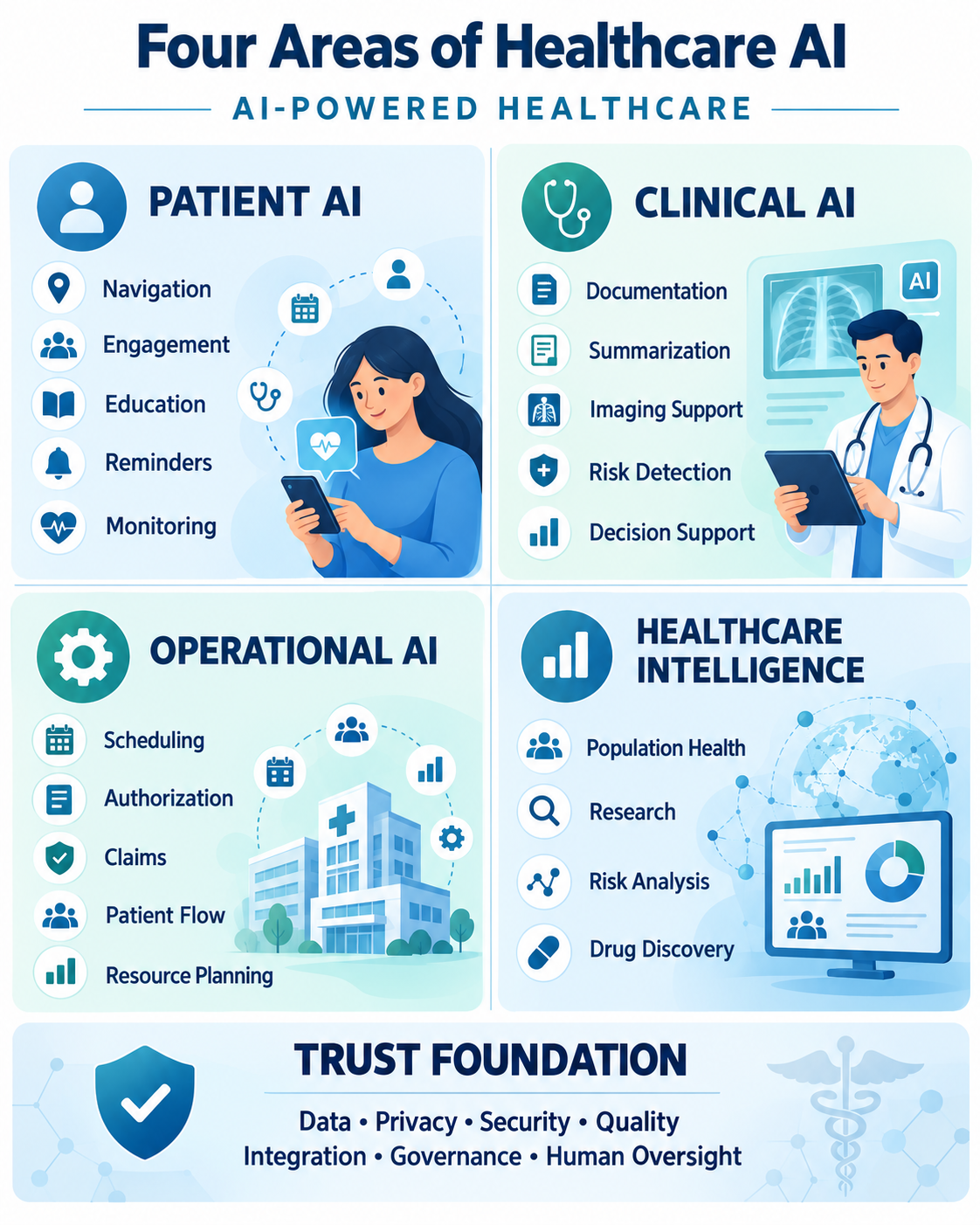
AI Around the Patient
For patients, one of the biggest opportunities is making healthcare easier to navigate. A patient may need help finding the appropriate service, scheduling an appointment, understanding what needs to happen before a visit, receiving reminders, accessing approved educational information or knowing when a follow-up is required. AI can support these interactions without trying to become the patient's doctor. For example, after a consultation, a patient may need to complete a laboratory test and schedule a follow-up appointment. Instead of waiting for the patient to remember every step, a connected system could help track where the patient is in the journey, provide appropriate reminders and identify when an expected action has not occurred. When the situation moves beyond administrative or informational support and requires clinical judgment, the system should know that responsibility needs to move to an appropriate healthcare professional.
AI Around the Clinician
Healthcare professionals work with a growing amount of information. A clinician may need to consider previous visits, medications, laboratory results, imaging, clinical notes and other patient information while also documenting the current interaction. AI can help reduce some of this information-processing burden. It may help organize relevant information, summarize records, assist with documentation, retrieve approved clinical knowledge or identify information that deserves closer attention. The distinction is important. Finding information is not the same as making a clinical decision. Summarizing a patient record is not the same as understanding the complete clinical context. Identifying a pattern is not the same as deciding how a patient should be treated. The closer AI moves toward decisions that can directly affect a patient's health, the more important validation, transparency and professional oversight become.
“The goal is not to make the physician less important. It is to reduce the information and administrative burden around the physician so that more attention can remain on the patient.”
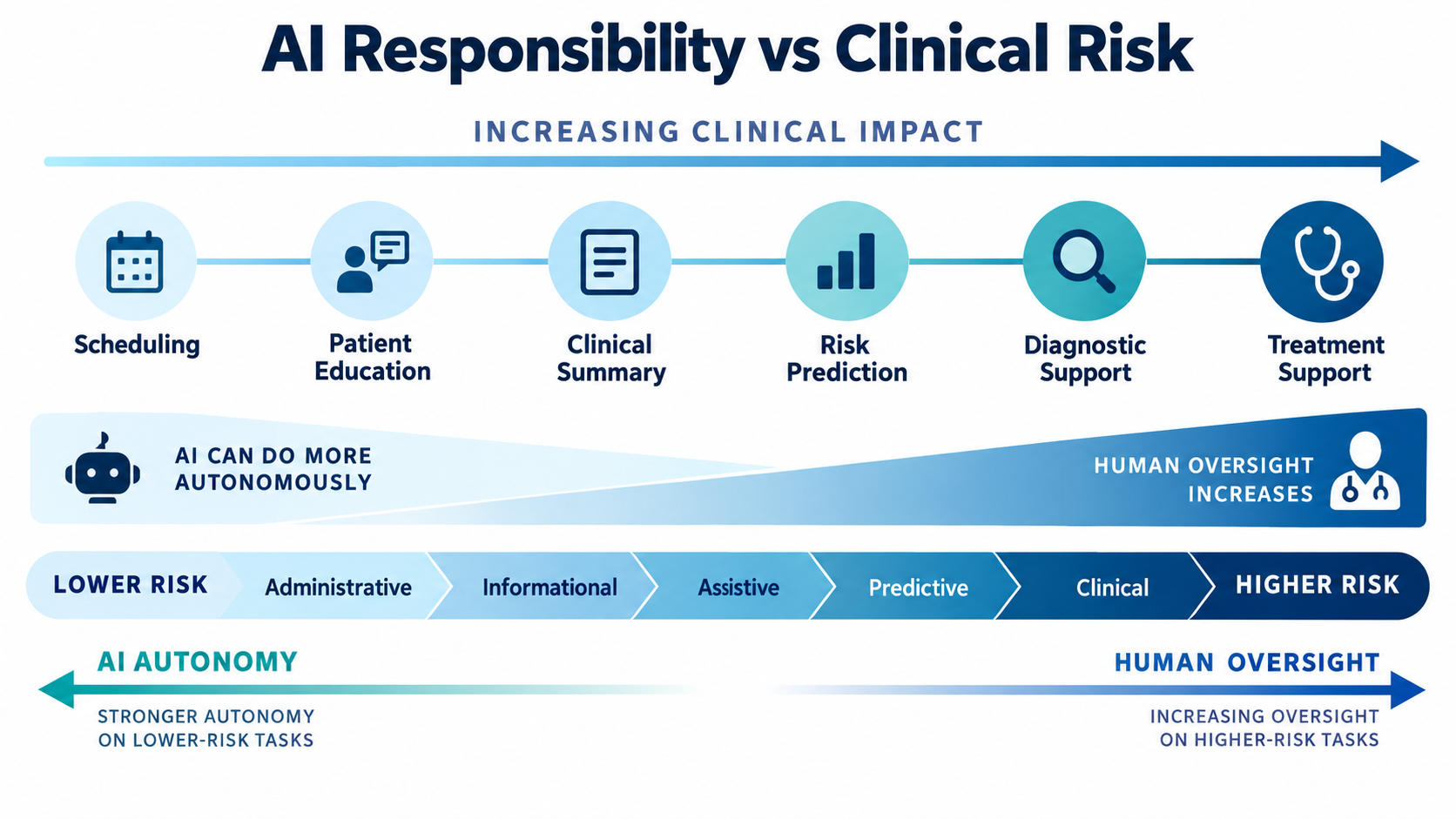
Not Every AI Decision Carries the Same Risk
Using AI to help schedule an appointment is very different from using AI to support a diagnosis or treatment decision. If an appointment assistant makes a mistake, the result may be inconvenience and additional administrative work. If a system influencing a clinical decision is wrong, the consequences can be much more serious. Healthcare organizations therefore cannot apply the same level of automation, validation and human oversight to every AI use case. As the potential impact on the patient increases, the controls around the AI system must increase with it.
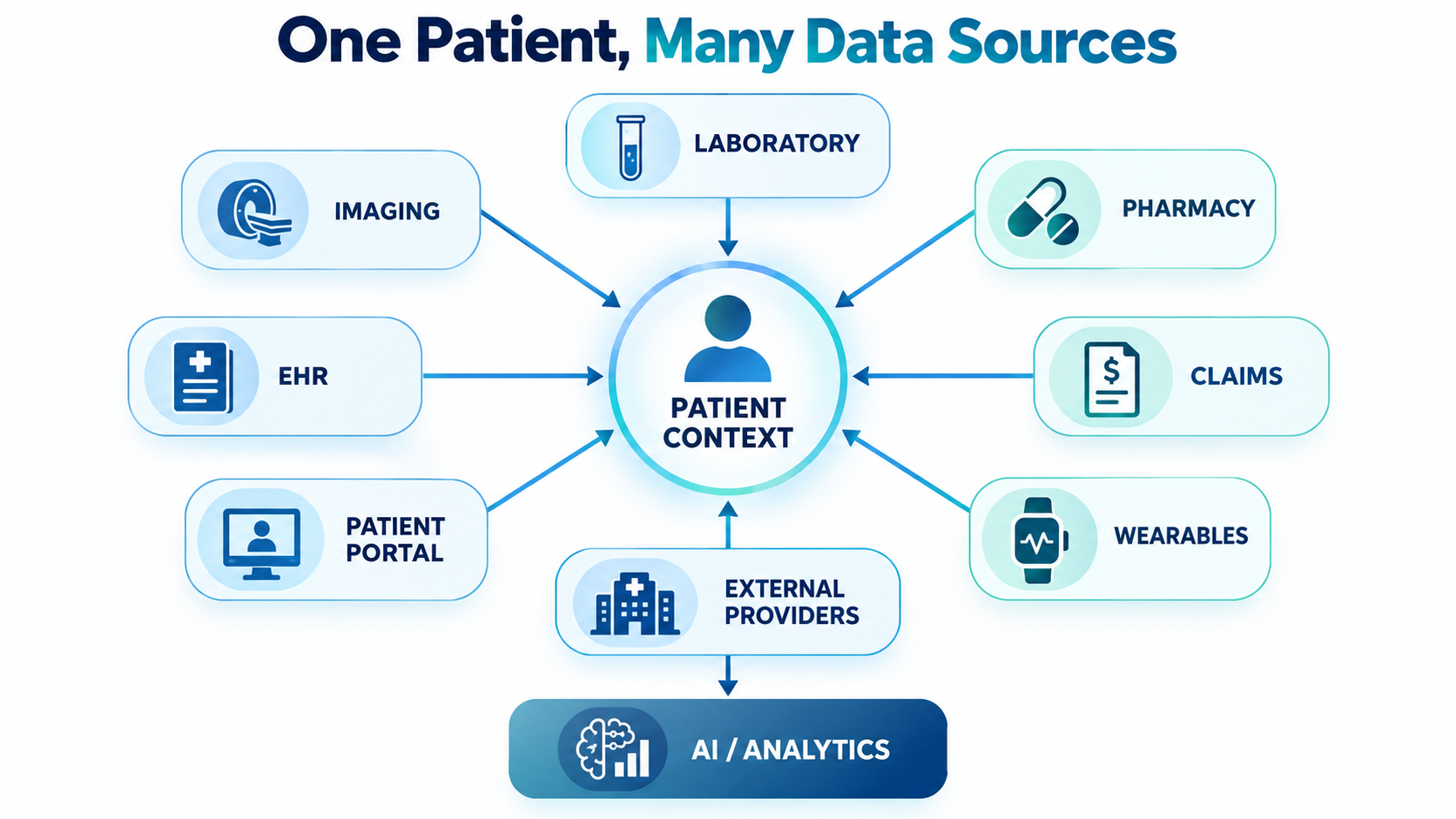
The Healthcare Data Problem Comes Before the AI Problem
AI depends on context, and healthcare context rarely comes from one system. Information about the same patient may exist across an electronic health record, laboratory system, imaging platform, pharmacy, insurance system, patient portal, contact center, wearable device and external healthcare provider. The challenge is not simply connecting these systems. The information may also be incomplete, delayed, duplicated or inconsistent. Consider a simple example. One system shows a medication as active. Another indicates that it was discontinued. A recent claim shows that the medication was dispensed, while the patient says they are no longer taking it. Which information should an AI system trust? A more sophisticated AI model does not automatically solve an inconsistent-data problem. Before AI can provide reliable assistance, healthcare organizations need to understand where information comes from, how current it is, how it is connected and which source should be trusted for a particular decision.
“AI can process healthcare information faster, but speed does not make incomplete or incorrect data trustworthy.”
A Successful Model Is Not Yet a Successful Healthcare Solution
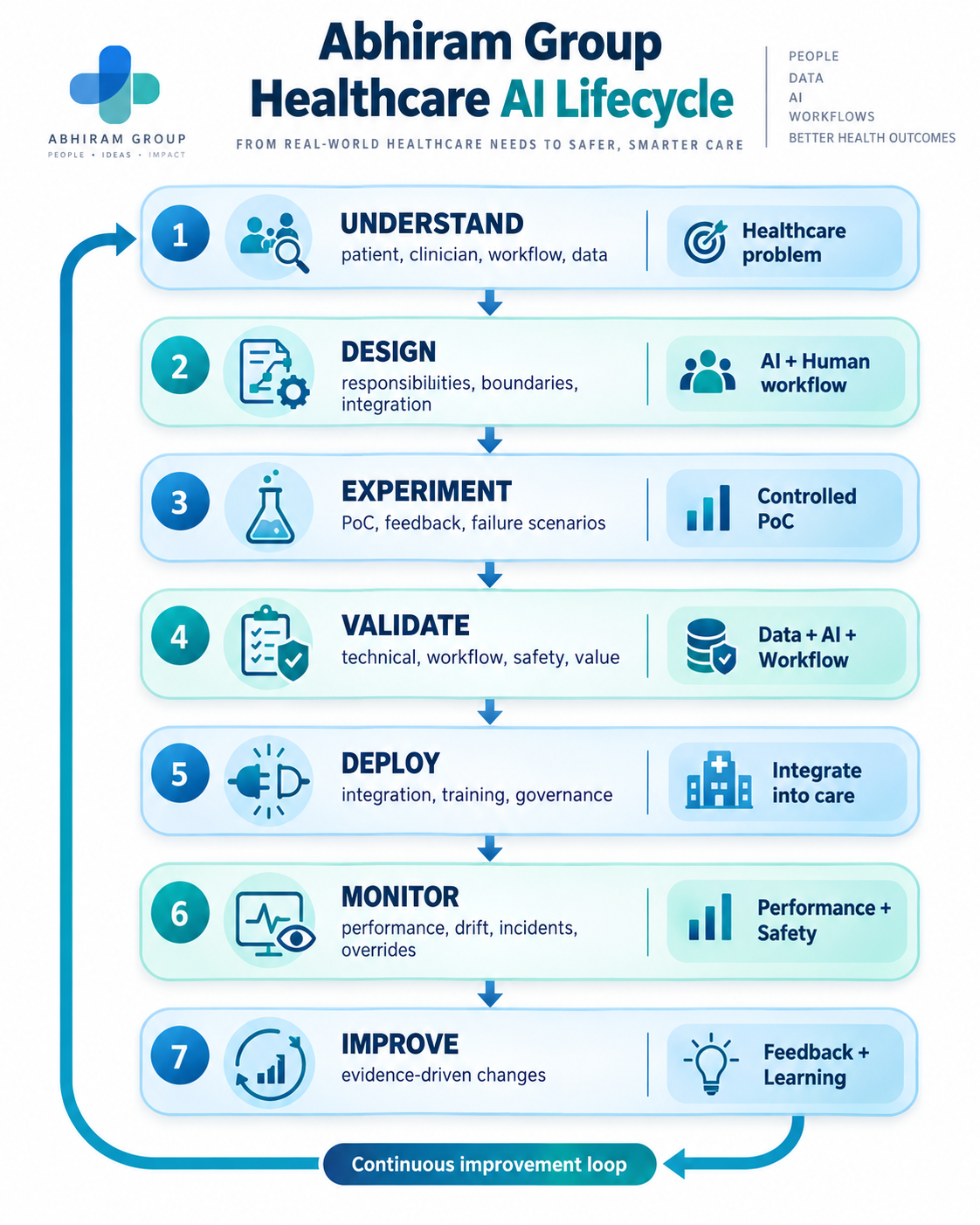
An AI model can perform well during development and still struggle when introduced into a real healthcare environment. Healthcare workflows change. Patient populations differ. Source data changes. Integrations fail. Users may interact with the system differently from the way developers expected. For that reason, testing cannot stop with model accuracy. A healthcare AI solution needs to be evaluated as part of the complete workflow in which it will operate.
What should we validate?
- Is the information being provided to the AI complete and current?
- Does the AI behave consistently when information is missing?
- What happens when two trusted sources provide conflicting information?
- Can the system recognize when it does not have enough information?
- Does it behave appropriately for patients or situations different from the original training or validation data?
- Does it transfer responsibility to a healthcare professional when required?
- Are AI-generated summaries complete and factually supported by the source information?
- What happens when an EHR, laboratory, scheduling or other dependent system is unavailable?
- Can healthcare professionals understand what information contributed to an AI-assisted recommendation?
- Are privacy and access controls maintained throughout the workflow?
- Can the organization detect when AI performance changes after deployment?
From Episodic Care to Connected Care
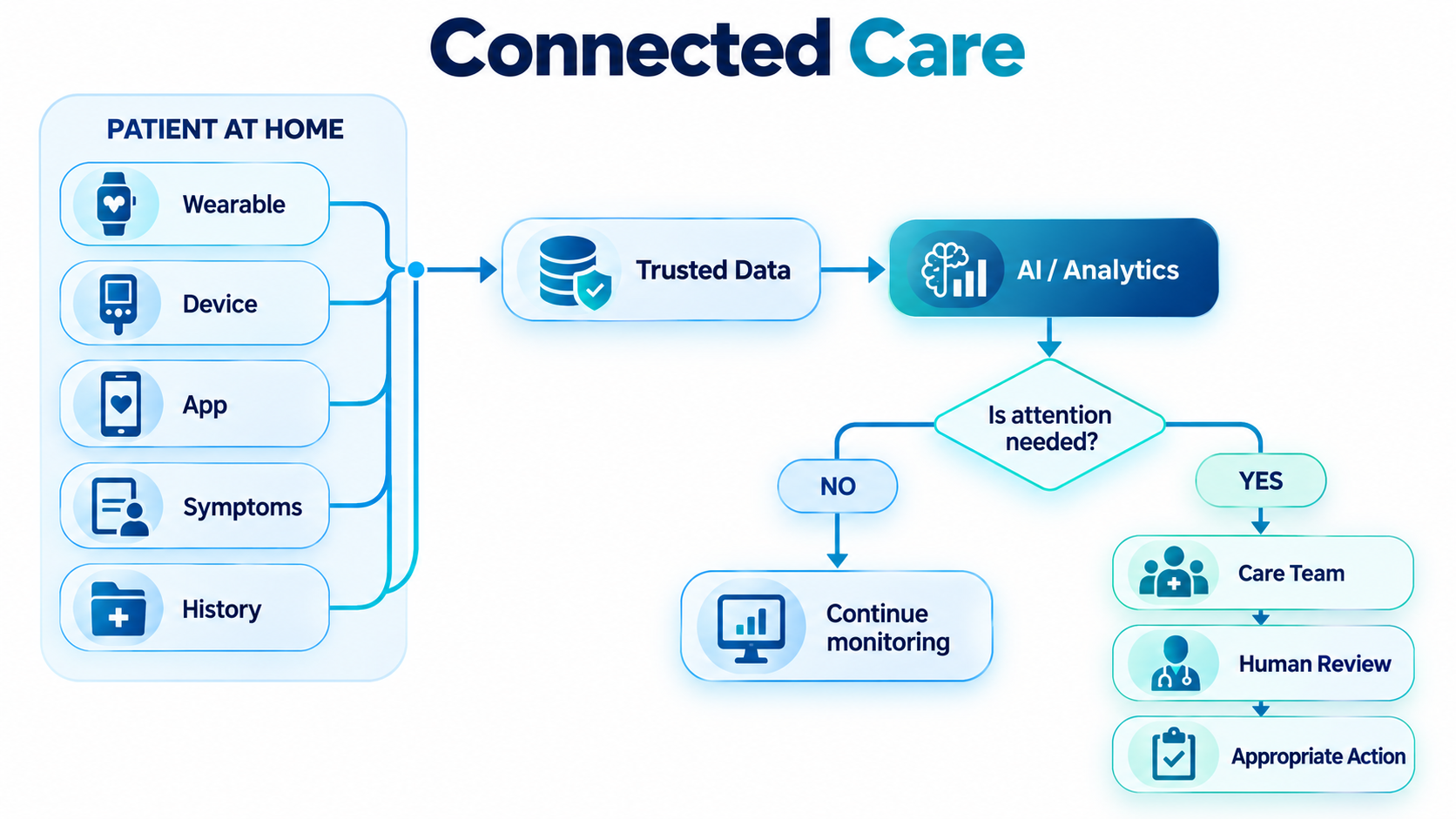
One of the more interesting possibilities for AI is what happens outside the traditional clinical visit. A patient managing a chronic condition may generate information through home monitoring, connected devices, patient-reported symptoms and digital interactions between appointments. Used appropriately, these signals may help healthcare teams identify situations that deserve attention earlier. But more data does not necessarily mean better care. A system that produces too many alerts can create another burden for healthcare professionals. A faulty device can create misleading information. An AI-generated alert has little value if nobody is responsible for reviewing or acting on it. Connected care therefore requires more than devices and algorithms. It requires clear workflows explaining what is monitored, what constitutes an important signal, who receives it and what happens next.
The Future Is AI-Augmented Healthcare
The future of healthcare is unlikely to be defined by a single AI model, chatbot or autonomous agent. It will be shaped by how effectively healthcare organizations connect patients, professionals, data, workflows and technology. Some routine activities will become increasingly automated. AI will help patients navigate healthcare and understand what needs to happen next. Clinicians will have better tools for finding and processing information. Healthcare organizations will use data more effectively to understand risk, demand and operational performance. But the role of people will remain fundamental. Clinical judgment, empathy, accountability and the ability to understand unusual situations cannot simply be treated as inefficiencies waiting to be automated. The objective should therefore not be maximum automation. The objective should be better healthcare.
“The measure of healthcare AI should not be how much work it removes from people. It should be whether it helps patients receive better support and helps healthcare professionals make better use of their time, information and expertise.”
From More Technology to Better Care
AI gives healthcare organizations new ways to work with information, support patients and assist healthcare professionals. But adopting AI alone does not create an intelligent healthcare system. The foundation still matters. Healthcare data needs to be trustworthy and appropriately connected. AI needs clearly defined responsibilities and boundaries. Higher-risk use cases need stronger validation and human oversight. Healthcare professionals need to understand how AI fits into their workflows. And organizations need to continue monitoring these systems after they move into real-world use. The practical path is therefore not to automate the entire patient journey at once. Start with a real problem. Understand the people and workflow involved. Establish the data required. Decide whether AI is appropriate. Test it in a controlled environment. Validate how it behaves when things go wrong. Introduce it carefully into the workflow. Measure what changes. Then expand where the evidence supports expansion. Done well, AI becomes less about the technology itself and more about what the healthcare system can do differently: connect information, reduce unnecessary work, identify situations that deserve attention and help patients remain better connected to their care. The future of AI-powered healthcare should not be defined by how intelligent the technology becomes. It should be defined by how intelligently we use it.