
Customer service has moved far beyond the traditional call center. Customers now interact with organizations through phone, chat, mobile applications, websites, email and other digital channels. They also expect these channels to work together. A conversation that starts with a chatbot may need to move to a human agent, while a customer calling for support expects the agent to understand the issue without asking them to repeat information already provided elsewhere. For organizations, this creates a different challenge. The objective is no longer simply to answer more calls with fewer people. It is to determine where AI can handle routine interactions, where it can assist employees, and where human judgment, empathy and accountability remain essential. An AI-powered contact center therefore should not be designed as a replacement for people. It should be designed as a coordinated service model in which AI, human agents, enterprise knowledge and business systems work together.
From Call Center to Contact Center
Traditional call centers were primarily built around telephone interactions. A customer called a number, navigated an IVR, waited in a queue and spoke with an available agent. The agent then searched for information, resolved the request where possible and manually recorded the outcome. That model is changing. Customers may now begin an interaction through a website or mobile application, ask a question through chat, switch to a phone call and later receive an update through email or another digital channel. The organization must maintain the context of that interaction across these channels. The contact center therefore becomes more than a telephone operation. It becomes an integration point connecting customers with people, digital channels, organizational knowledge and enterprise systems.
Evolution of Customer Service
Branch-Centric Service
Traditional Call Center
Multi-Channel Contact Center
AI-Assisted Contact Center
AI + Human Intelligent Contact Center
Why Traditional Contact Centers Struggle
The pressure on a contact center is not created by call volume alone. A significant part of an agent's time can be spent understanding the customer's request, searching multiple sources for the correct information, navigating applications, documenting the conversation and determining the next action. The problem becomes more difficult when products, policies or procedures change frequently. Experienced agents may know where to find information, while newer agents require more assistance and training. Supervisors must also monitor interactions, support escalations and maintain service quality. Simply adding more agents does not solve these structural problems. Organizations need to examine which activities genuinely require human capability and which activities can be supported or performed by technology.
Typical operational challenges include:
- Customers repeating the same information when moving between channels.
- Agents searching multiple systems and knowledge sources during a conversation.
- Manual preparation of call notes and interaction summaries.
- Inconsistent answers when knowledge is outdated or difficult to locate.
- Long learning curves for new agents.
- Supervisors manually reviewing only a limited number of interactions.
- High volumes of repetitive enquiries consuming agent capacity.
- Limited use of customer conversations to identify recurring product or service problems.
- Difficulty maintaining service consistency across office, satellite and remote operating models.
The Key Point Is Still People
Introducing AI does not remove the importance of people from customer service. In many situations, it makes the distinction between human and machine responsibilities more important. AI is well suited to processing information at scale. It can transcribe conversations, identify likely intent, search approved knowledge, summarize interactions and detect patterns across large numbers of conversations. People bring different capabilities. They understand ambiguity, exercise judgment, handle unusual situations, manage sensitive conversations and provide empathy when a customer needs more than a standard response. The objective should therefore be to assign work according to these strengths rather than attempting to automate every interaction.
The future contact center is not AI instead of people. It is AI handling what machines do well, while people focus on what requires judgment, empathy and accountability.
Human + AI Responsibility Model
AI LED
FAQ Resolution
Transcription | Knowledge Search | Summarization | Intent Detection
AI + HUMAN
Next-Best Action
Decision Support | Case Investigation | Quality Monitoring | Escalation Support
HUMAN LED
Complex Complaints
Empathy | Exceptions | Sensitive Situations |Accountable Decisions
Where AI Can Make an Immediate Difference
The value of AI becomes clearer when it is applied to specific parts of the customer-service workflow rather than introduced as a broad technology initiative.
Five areas provide practical starting points.
- Conversation transcription and summarization — Convert voice conversations into text and generate structured interaction summaries, reducing repetitive after-call documentation.
- Real-time knowledge assistance — Understand the subject of the conversation and retrieve relevant information from approved organizational knowledge while the agent is speaking with the customer.
- Response quality support — Help agents reference current procedures and knowledge instead of depending entirely on memory or manually locating information.
- Supervisor and quality assistance — Analyze interactions and identify conversations that may require review, coaching, escalation or further investigation.
- AI-powered self-service — Allow customers to resolve appropriate routine enquiries through voice or chat while maintaining a clear path to human assistance.
What an AI-Powered Contact Center Could Look Like
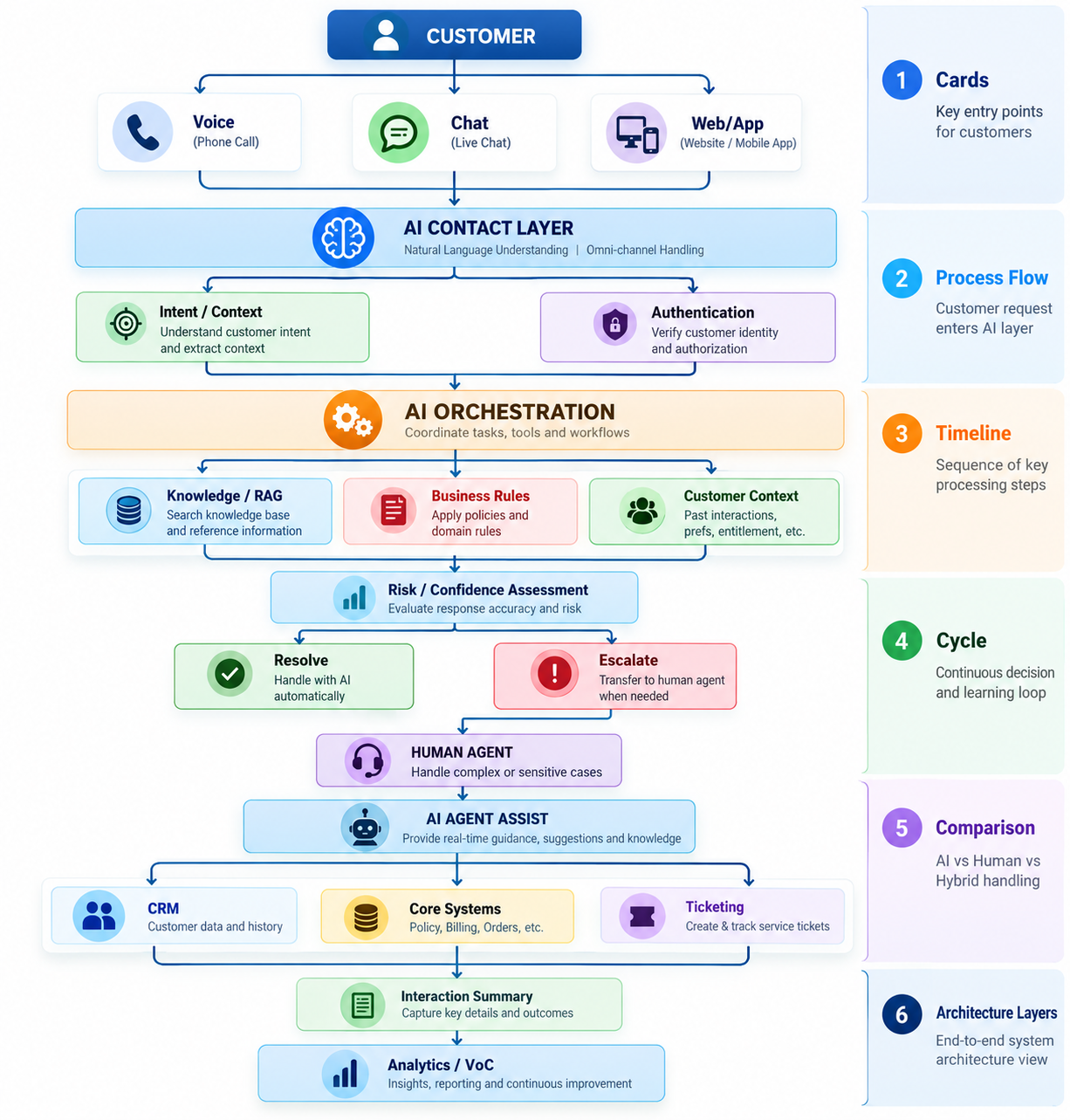
An enterprise contact-center solution requires more than a chatbot connected to a language model. AI needs controlled access to organizational knowledge, customer context and business systems. It also needs rules determining what it can answer, what actions it can perform and when an interaction must be transferred to a person. A conceptual architecture can separate customer channels from AI orchestration, enterprise knowledge and transactional systems while keeping human agents within the service flow.
The AI Should Know What the Organization Knows—not Invent What It Doesn't
One of the most important design decisions is how AI obtains the information used to respond to customers. For enterprise customer service, unrestricted generation creates unnecessary risk. The solution should be grounded, where appropriate, in controlled organizational knowledge such as approved FAQs, product information, procedures, policies and service instructions. When the required information is unavailable, contradictory or outside the system's permitted scope, the safer outcome may be escalation rather than generating a confident answer. This also changes knowledge management. Outdated or conflicting knowledge can become an AI problem just as easily as it was previously an agent problem.
Proof of Concept: From AI Conversation to Human Resolution
To move beyond a conceptual discussion, we can demonstrate the model through a small proof of concept. Consider a fictional banking scenario. A customer contacts the service channel and reports: “My debit card was charged twice for ₹4,500. What should I do?” The objective of the PoC is not to allow AI to independently make a financial decision. It is to demonstrate how AI can understand the problem, retrieve approved information, collect appropriate context and transfer the interaction to a human agent when the situation requires controlled action. No real customer, account or banking data should be used in the demonstration.
PoC Customer Screen
Customer conversation
Detected intent
AI response
Escalation status
PoC Agent Assist Screen
Live Conversation
Customer Context | Detected Intent | Suggested Knowledge | Recommended Action | Generate Summary
- Customer starts the interaction through the AI service channel.
- AI identifies the likely intent as a duplicate card transaction.
- The system retrieves relevant information from the approved PoC knowledge base.
- AI provides permitted initial guidance.
- The orchestration layer determines that transaction-specific investigation requires human handling.
- The interaction is transferred to an agent.
- The agent receives the conversation context instead of asking the customer to explain the problem again.
- AI continues assisting the agent with relevant knowledge during the conversation.
- At completion, the system generates a draft interaction summary.
- The final interaction becomes part of the service analytics and Voice-of-Customer dataset.
The AI Should Know What the Organization Knows—not Invent What It Doesn't
One of the most important design decisions is how AI obtains the information used to respond to customers. For enterprise customer service, unrestricted generation creates unnecessary risk. The solution should be grounded, where appropriate, in controlled organizational knowledge such as approved FAQs, product information, procedures, policies and service instructions. When the required information is unavailable, contradictory or outside the system's permitted scope, the safer outcome may be escalation rather than generating a confident answer. This also changes knowledge management. Outdated or conflicting knowledge can become an AI problem just as easily as it was previously an agent problem.
Knowing When AI Should Stop
A mature AI contact-center design needs explicit boundaries. Successful automation is not measured only by how many conversations avoid a human agent. The system must recognize circumstances where automation should stop and responsibility should move to an appropriate person or controlled enterprise process.
Escalation may be appropriate when:
- AI confidence is below an approved threshold.
- Required organizational knowledge cannot be found.
- Available knowledge is conflicting or outdated.
- The customer requests human assistance.
- The interaction involves a sensitive complaint or exceptional situation.
- A transaction requires authentication or authorization beyond the AI's permitted scope.
- The conversation requires human judgment or empathy.
- A dependent enterprise service is unavailable.
- AI output conflicts with information returned by a system of record.
- Organizational or regulatory rules require human review.
A Successful Demo Is Not Evidence of a Production-Ready AI System
An AI contact-center PoC can appear impressive when every demonstration follows the expected path. Enterprise systems, however, must also work when conversations are incomplete, ambiguous or unexpected. Quality Engineering therefore needs to validate not only whether AI produces a useful answer, but whether the entire interaction behaves safely when knowledge, integrations, customers or downstream systems behave differently from expected.
Our PoC should deliberately test:
- A normal FAQ that AI can resolve.
- An incomplete customer question.
- A customer changing intent during the conversation.
- Multiple intents in the same conversation.
- Missing knowledge.
- Conflicting knowledge articles.
- An unsupported request.
- Explicit request for a human agent.
- Incorrect or unsupported AI output.
- Authentication failure.
- CRM or backend service failure.
- Conversation-context transfer to the human agent.
- Accuracy of the generated interaction summary.
- Handling of sensitive information.
- Supported multilingual interactions, if included in the PoC.
From Customer Conversations to Business Intelligence
A contact center should not only resolve individual enquiries. Collectively, customer conversations provide information about recurring problems, confusing processes, product issues and service gaps. Once interactions are appropriately captured and classified, organizations can analyze recurring intents, escalation reasons, complaint themes and other patterns. These insights can then be shared with product, operations, technology and business teams. The result is a feedback loop in which customer service contributes to improving the underlying product or process—not simply answering the same question repeatedly.
Voice-of-Customer Improvement Loop
Customer Interactions
Voice / Chat / Digital Channels
Transcription & Classification
Intent / Topics / Patterns
Recurring Customer Issues
Business + Product + Operations
Process / Product Improvement
Updated Enterprise Knowledge
Improved Customer Service
The Future Contact Center Is Hybrid
The likely direction is neither a completely human contact center nor a completely autonomous AI service operation. Routine and well-understood enquiries can increasingly begin with AI. Human agents can receive AI assistance for knowledge discovery, context and documentation. Complex, sensitive or exceptional situations can move to people with the interaction history preserved. Agents themselves may operate from centralized facilities, satellite centers or approved remote environments, provided security, privacy, supervision and operational controls are designed appropriately. The competitive difference will not come simply from having a chatbot or adopting a particular AI model. It will come from how effectively organizations combine customer channels, trusted knowledge, enterprise systems, AI capabilities and people into one service model.
Technology Changes the Contact Center. People Define the Experience.
AI creates an opportunity to redesign customer service rather than simply automate existing call-center tasks. Transcription, summarization, knowledge retrieval, self-service and interaction analysis can reduce repetitive work and give agents better information. At the same time, customer service still contains situations that require judgment, accountability, empathy and human intervention. The practical path is therefore incremental: identify suitable interactions, establish trusted enterprise knowledge, define AI boundaries, integrate with existing systems, test expected and unexpected scenarios, measure the results and expand automation where evidence supports it. A well-designed contact center should make AI largely invisible to the customer. What the customer should experience is simpler: less repetition, faster access to useful information, smoother transitions between channels and a person available when a person is actually needed.